
Multivariate Testing vs AB Testing: Which One Should You Actually Use?

Published by grace • July 20, 2026

The debate around multivariate testing vs ab testing goes beyond academics—major software companies like Microsoft and Google each conduct over 10,000 tests annually to optimize their products. The question isn’t whether you should test, but which testing method will give you the most valuable insights for your specific situation.

Both ab testing and multivariate testing use the same core mechanism to compare different versions of your product or web page. A/b split testing compares two versions of a single variable to determine which performs better. Multivariate experiments test multiple variables at once to understand how they interact. This piece will walk you through what is a/b testing, what is multivariate testing, and more crucially, how to choose the right method for your business goals.

Understanding A/B split testing vs multivariate experiments

What is A/B testing

A/B testing splits your traffic between two versions of a page to determine which performs better at achieving a specific conversion goal. Site visitors get bucketed into version A or version B. You track how they interact with each page. This method isolates cause and effect. If version B wins, you know exactly why because only one thing changed.

The test can compare two different designs or focus on a single element. A company might test their current homepage with in-text calls to action against a new version with a top bar advertising their latest product. A pet store might find that 85% more users sign up for a newsletter held up by a cartoon mouse rather than one emerging from a boa constrictor’s coils. Testing multiple variations of one element might require an A/B/C/D test, though this splits traffic into thirds or fourths.

What is multivariate testing

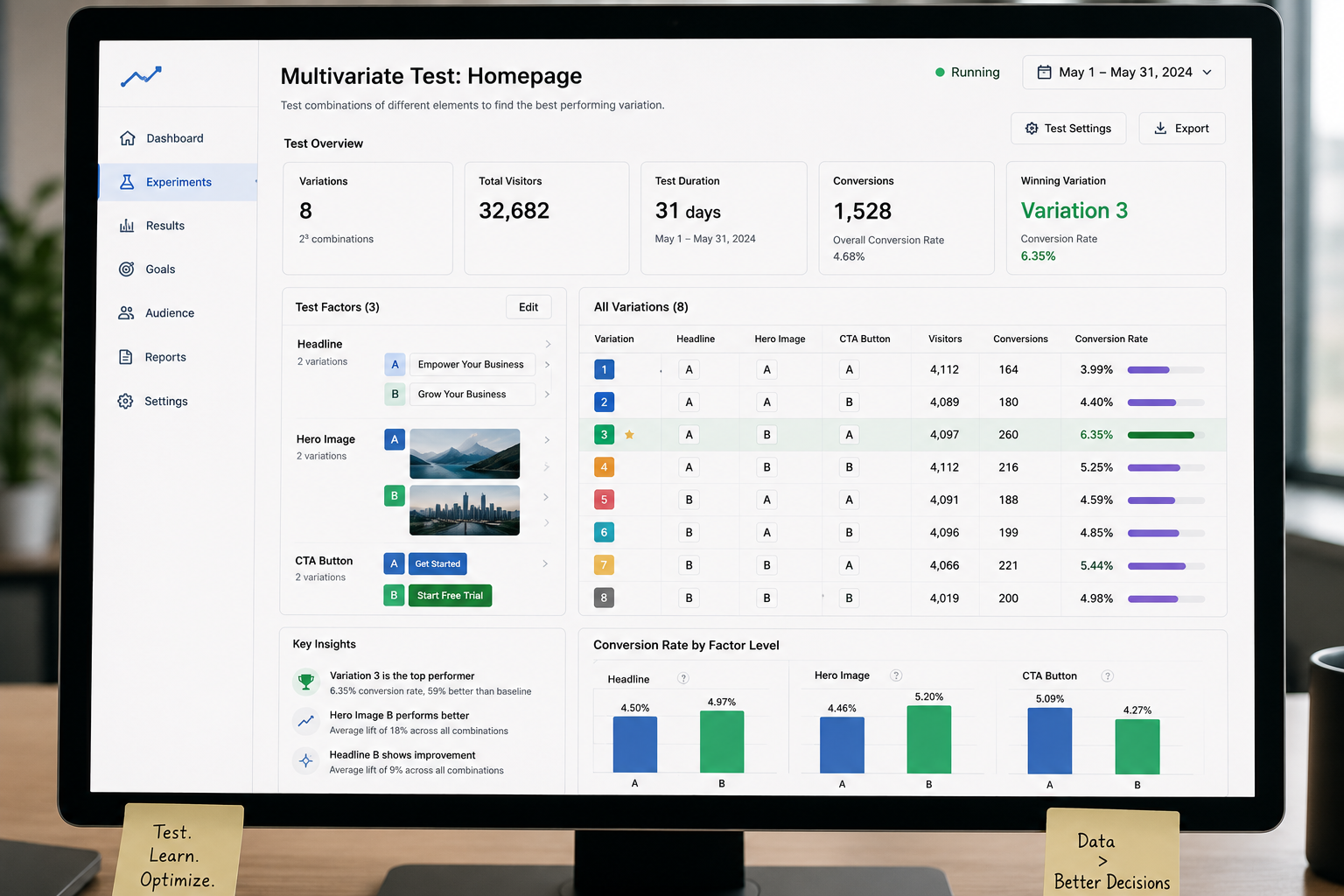
Multivariate testing uses the same mechanism as A/B testing but compares a higher number of variables. This reveals how these elements interact with one another. You might test two sign-up form lengths, three headlines, and two footers at once rather than creating different designs. Traffic gets funneled to all possible combinations of these elements.

This approach creates substantially more variations than standard A/B tests. Testing three headlines, two CTAs, and two images creates 12 combinations that visitors experience. Each possible variant combination needs comparison, which is why multivariate testing requires substantial traffic. The payoff is a richer answer. You learn which combination wins and which specific element does the most work. You also learn whether elements interact in unexpected ways.

Ground examples of each method

Hyundai Netherlands ran a multivariate test on their car landing pages. They tested SEO-friendly copy versus original copy, an additional CTA versus a single CTA, and large photos versus thumbnails. The winning version generated a 62% uplift in conversion rate and a 208% increase in click-through rates. Microsoft Office tested their landing page’s hero shot, title, description, call to action, and resource links through multivariate testing. This achieved a 40% increase in conversions.

These examples demonstrate the power of testing multiple elements together rather than running sequential tests for each variable.

Comparing A/B testing and multivariate testing

Test structure and design

The fundamental difference between multivariate testing vs ab testing lies in how many elements change at once. An A/B split test compares two versions of a single variable. Multivariate testing gets into multiple elements at the same time to understand their interactions. You test two headlines, two form buttons and two images together to create eight page combinations that visitors experience. Traffic splits differently too. A/B testing divides visitors evenly between two pages, but multivariate experiments split traffic into quarters, sixths, eighths or even smaller segments.

Sample size and traffic needs

Traffic requirements differ between these methods. A/B testing needs nowhere near as much traffic since you’re only splitting visitors in half. Multivariate testing needs more visitors because each variation receives a much smaller portion of traffic than in a simple A/B test. A good rule suggests doubling your traffic or sessions with every variant you introduce. Sites with 1,000 daily views can run A/B tests, but those same 1,000 views spread across 12 multivariate variations give each one only 83 views.

Time to results

A/B testing delivers reliable results within days, one to two weeks in most cases. Multivariate tests might need weeks or even months to reach statistical significance. The more combinations you test, the longer your experiment runs.

Analysis complexity

A/B tests produce straightforward answers. One headline yields a 5% conversion rate and another yields 1.2%, so you have a clear winner. Multivariate testing gets trickier since you’re looking at numerous combinations to determine what moves the needle. You need stronger statistical understanding to set up and analyze multivariate results.

Best use cases for each method

Use A/B testing with moderate traffic, quick insights or one specific change. Multivariate testing works best with high-traffic pages, refining already optimized designs or understanding how elements interact.

How to decide which testing method to use

Assess your traffic volume

Traffic determines which testing method you can run. Sites with under 10,000 visitors each month face challenges with reliable A/B testing. You can run tests with 10,000 to 100,000 visitors per month, but should focus on major changes rather than button color tweaks. The sweet spot starts at 100,000 to 1,000,000 visitors per month. You can detect smaller changes and run multiple tests at this level.

Multivariate testing demands substantially more traffic. You need at least 10,000 visitors per month to ensure each variant receives enough traffic for meaningful results within a reasonable timeframe. Testing two headlines and two images creates four combinations. Adding a third element with two variations jumps to 18 combinations. Each combination needs sufficient traffic to reach statistical significance.

Think over your testing goals

Your objective shapes your method choice. A/B testing works when you just need clear outcomes on single variables, like headline changes. Multivariate testing suits situations where you must analyze how text and imagery influence user behavior together. It excels at refining complex pages where various elements affect conversion rates.

Stick with A/B testing for major layout redesigns or substantial changes. Multivariate testing makes incremental improvements to existing designs rather than dramatic overhauls.

Assess your resources and timeline

A/B tests provide faster results and make them suitable for time-sensitive campaigns. Multivariate tests require longer periods to achieve statistical significance due to the number of variations being tested. An A/B test reaches conclusions faster if you need a decision within two weeks.

Match test type to business stage

Startups operate under high uncertainty and limited resources. Building to learn rather than building to last means A/B testing arranges better with startup constraints. Testing bold changes with limited traffic produces clearer trends than waiting months for multivariate significance.

Using both A/B testing and multivariate testing together

Start with A/B testing for major changes

Start with A/B testing first at the time you begin website optimization. The test structure is simpler and less complex, which makes it better suited for low-traffic pages. Tests reach statistical significance quicker than multivariate testing because you have fewer variants. A/B testing works best for straightforward comparisons between two radically different designs or testing single elements.

Follow up with multivariate testing for refinement

Multivariate tests fine-tune your landing page and help you learn about future development once it gets good traffic. This sequential approach helps you get the best conversion rate possible. Use A/B testing first to determine which option converts best, then apply multivariate testing for optimization. Think of A/B testing as finding the “global maximum” and MVT as refining toward the “local maximum”.

Building a complete testing strategy

View website optimization as an ongoing process rather than one-off projects. Building a culture of experimentation creates deep, evidence-based understanding of customer behavior. This organizational learning becomes your strategic asset. Multivariate testing suits elements used on pages of all types, such as universal CTAs or navigation, since testing on one page applies to others without additional tests.

Common mistakes to avoid

Don’t stop tests before reaching statistical significance. Avoid testing on sites that change constantly with MVT since winning experiences rely on element interplay that gets disrupted when content changes routinely. A/B testing allows faster and more reliable iteration in these cases.

Choosing between multivariate testing vs ab testing isn’t about picking a winner. Both methods serve different purposes in your optimization strategy. A/B testing works best at the time you have moderate traffic and need quick wins on major changes. You’ve built traffic and found what works. Use multivariate testing to refine the details. The real-life competitive advantage comes from building a testing culture where experimentation becomes routine, not occasional.