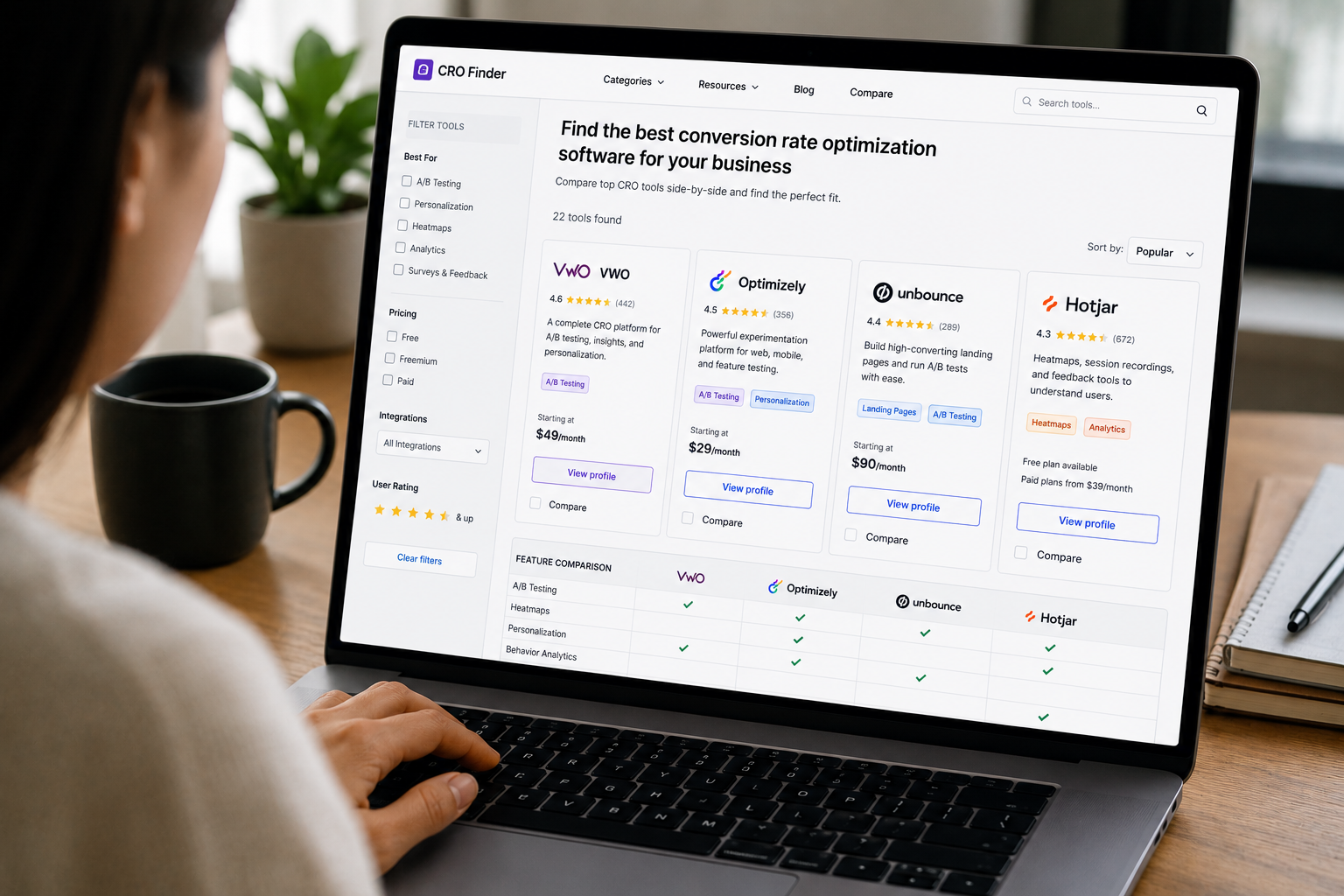
Conversion rate optimization tools are specialized software that help you understand why visitors aren’t converting and give you the means to fix it. These platforms answer one question: why do site visitors behave the way they do? Conversion rate optimization software provides concrete evidence so you can make changes with confidence rather than guessing what might work.

Best Conversion Optimization Tools That Actually Boost Sales in 2026
Published by grace • July 29, 2026
Businesses that implement conversion optimization tools report an average ROI of 223%. The math behind this is straightforward: if you increase your conversion rate from 2% to 3%, you’ve just grown revenue by 50% from the same traffic. Yet, 25% of businesses say outdated technology remains their biggest problem when trying to improve conversions.
This piece will walk you through the best conversion rate optimization tools available in 2026. We’ll explore top conversion rate optimization platforms across A/B testing, analytics, heatmaps and AI-powered solutions. You’ll learn how to choose the right conversion rate optimization software for your business and avoid common mistakes. More importantly, you’ll discover how to use these website conversion tools to boost your bottom line.

How CRO tools impact your bottom line
The cost of acquiring new customers continues to climb. Extracting more value from your existing traffic has become one of the most influential investments available. Your revenue grows by 50% when you increase your conversion rate from 2% to 3% without spending more on paid campaigns. This difference matters because your fixed marketing costs remain the same while you squeeze more value from what’s already in place.
Conversion optimization tools serve two main functions: driving quality traffic to your site and increasing action rates once visitors arrive. They help you target more of your ideal customers while lowering your customer acquisition cost. You’re wasting valuable resources if you’re spending too much finding the wrong types of customers. Research shows that AI agents handling original marketing interactions and optimizing the front end of the funnel can boost free-trial sign-up conversions by 78% while increasing the pipeline of high-quality prospects by 25%.
Key types of conversion optimization platforms
Best conversion rate optimization tools fall into three broad categories. Quantitative tools measure key performance data across your website and mobile app. Qualitative user behavior tools show you areas that need improvement through visual features like heatmaps and session recordings. Testing tools enable experiments with your changes to determine which versions produce optimal results.
The difference between analytics, testing, and behavior tools
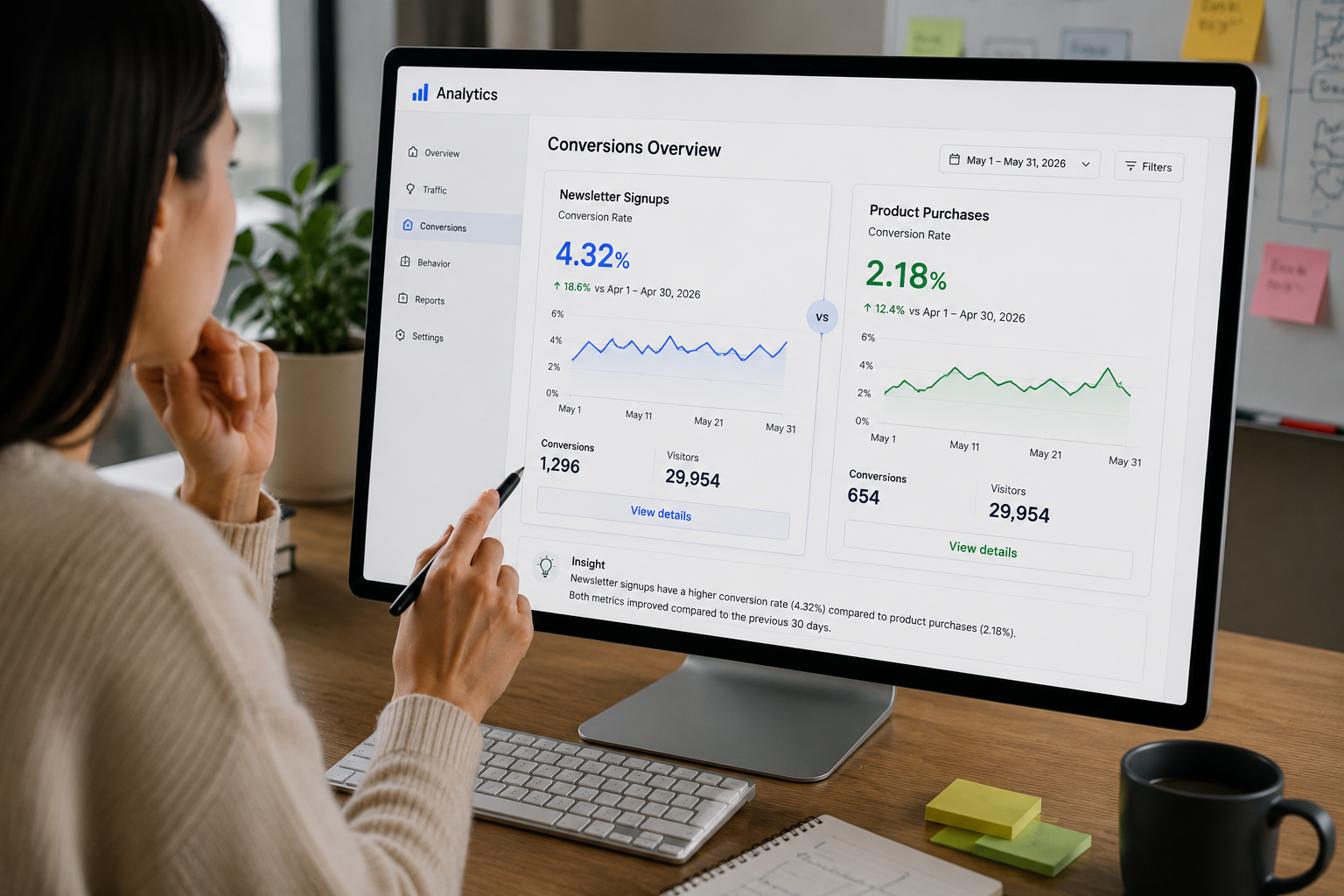
Analytics platforms tell you what happens on your website through metrics like traffic source, conversion rate, and session duration. They flag problems but lack context. Behavior tools reveal why users act the way they do by tracking specific events and actions tied to distinct users. Session recordings provide real examples of customers navigating your site. Heatmaps show exactly where users click, scroll, and get stuck.
Testing platforms let you confirm your hypotheses. A combination of quantitative and qualitative data analysis results in the most meaningful and useful insights. Quantitative gives you the what of the data, but qualitative data reveals the why a visitor took an action.
Selecting the right conversion rate optimization platform depends on understanding what each category delivers. Here’s how the top conversion rate optimization tools break down in five distinct categories.

Best A/B testing and experimentation platforms
Optimizely remains the enterprise standard for A/B testing and supports multivariate tests for web, mobile and backend systems. VWO provides testing with visual editors for marketers who need quick page changes without coding requirements. Statsig gained traction among product-led companies where engineers own experimentation. It offers detailed APIs and immediate traffic allocation. AB Tasty serves mid-market teams with GDPR compliance requirements, while Kameleoon emphasizes AI-powered personalization among other experimentation features. Convert appeals to privacy-first agencies with strong HIPAA and GDPR compliance.
Top session recording and heatmap tools
Hotjar combines heatmaps, session replays and feedback tools to identify where visitors struggle. Microsoft Clarity offers completely free session recording with no traffic limits. This makes it available for startups. Mouseflow specializes in form analytics and tracks which specific fields cause abandonment. Fullstory provides AI-powered session summaries that surface patterns without watching hours of footage. Smartlook focuses on mobile app analytics with native gesture tracking for iOS and Android.
Leading analytics and funnel tracking software
Google Analytics 4 serves as the baseline analytics platform and offers event-based tracking with funnel visualization at no cost. Mixpanel specializes in product analytics with event tracking that follows individual user experiences. Kissmetrics tracks customers as real people through sessions and devices. This helps businesses see movement through complex funnels. Funnelytics provides visual funnel mapping that shows exactly how customers move from landing pages to checkout.
AI-powered conversion optimization platforms
Pathmonk users see an average conversion boost of 50-60%. Some clients experience lifts as high as 600-700%. The platform uses immediate behavioral data to predict visitor actions. Humblytics launched as the only agent-native A/B testing platform and allows AI agents to run complete tests in 12 minutes.
All-in-one website conversion tools
VWO unites testing, analytics and personalization into a single platform. Unbounce specializes in landing page optimization with Smart Traffic AI that directs visitors to variants where they’re most likely to convert. Instapage focuses on 1:1 ad-to-page personalization for paid campaigns.
Shopping for conversion rate optimization software starts with understanding one fact: finding out why visitors hesitate, testing a fix, and confirming it drove business are three different jobs handled by three different kinds of software.

Match tools to your conversion goals
Your business model determines which conversion rate optimization platform fits best. Ecommerce needs product-page behavior tracking and checkout visibility. SaaS requires onboarding funnels and pricing-page analysis. Lead generation demands landing page optimization and form analytics. Start by listing your must-haves, nice-to-haves, and requirements that aren’t priorities right now.
Think about your traffic volume and technical resources
Free tools work well below 5,000 monthly visitors. Paid conversion optimization tools justify their cost through deeper segmentation and revenue attribution once you cross that threshold. Review your team’s technical proficiency therefore. Prioritize no-code visual editors if you lack in-house developers. Look for API-first platforms that support custom event tracking if you have a dedicated engineering team.
Review integration capabilities with your existing stack
Your conversion rate optimization tool needs native integration with your CRM and primary analytics platform to prevent data silos. Verify the platform offers open APIs for custom integrations if direct connections don’t exist.
Budget considerations and ROI expectations
Some tools charge by tracked sessions, others by active experiments. A 5% conversion lift generates $2,500 extra per month if your landing page drives $50,000 monthly revenue. Calculate whether that gain exceeds your tool investment.
Start with one category and expand gradually
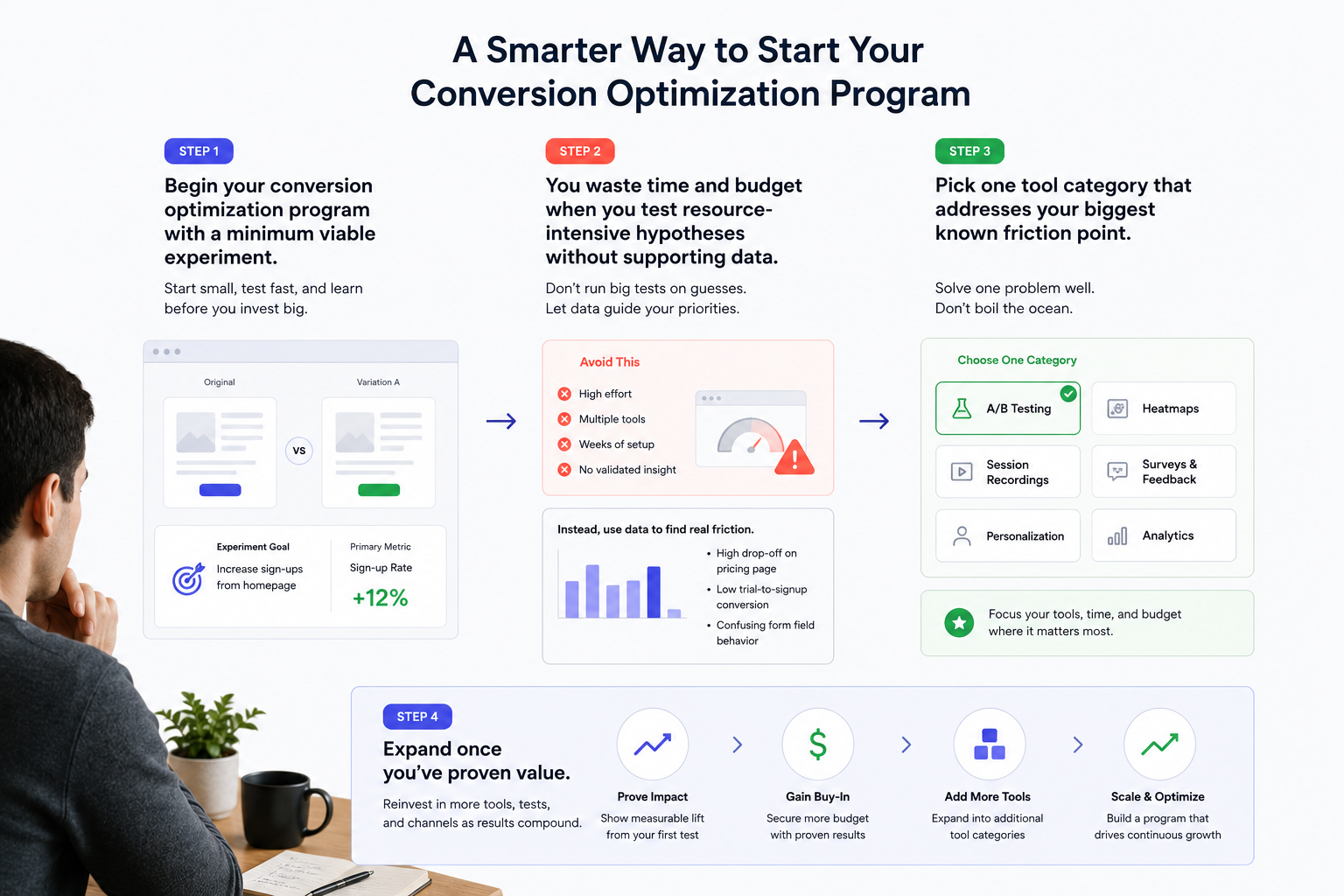
Begin your conversion optimization program with a minimum viable experiment. You waste time and budget when you test resource-intensive hypotheses without supporting data. Pick one tool category that addresses your biggest known friction point. Expand once you’ve proven value.

Connect quantitative data with qualitative insights
Quantitative methods show measurable patterns at scale. Qualitative methods reveal motivations and mental models. Analytics tell you what happens and where drop-offs occur. Session recordings and user interviews explain why visitors abandon. This layered understanding connects what’s happening with why it’s happening. Quantitative data from analytics identifies problem areas. Use qualitative tools like heatmaps and recordings to understand why it happens.
Run tests that move the needle
Every test needs a clear hypothesis backed by research. Calculate your required sample size before you launch, then stick to it. Only 1 out of 7 A/B tests delivers results that are meaningful. Run tests until they reach 95% confidence level. Test one element at a time to isolate what creates an effect.
Common mistakes to avoid when using conversion optimization tools
Vibes-based tests produce skewed data. You drop website performance when you stop tests before statistical significance. Pages with low traffic yield unreliable results. You create blind spots in your funnel when you ignore micro-conversions like form fills.
Conversion optimization tools deliver real results when you choose platforms that match your needs. Begin with one category that addresses your biggest friction point and a clear hypothesis backed by evidence. For example, you can combine quantitative analytics with qualitative behavior insights. This reveals not just what visitors do but why they do it.
Test with statistical rigor and implement these tools methodically. You’ll capture more value from your existing traffic without inflating your acquisition costs.