Real Challenges of Running a DTC Business
The direct-to-consumer model delivers significant advantages, but you need to confront operational realities that many founders underestimate to execute it successfully.
Understanding the direct to consumer meaning has become everything in business as DTC sales were expected to surpass $150 billion in 2022, representing a 16.9% year-over-year increase. Legacy brands are adding DTC options and new companies are launching with this model from day one. The change is clear: cutting out intermediaries means keeping more profits and controlling your brand story.
What does direct to consumer mean for your business in 2026? We’ll break down the d2c meaning, explore how the dtc meaning marketing has evolved, get into why direct to consumer brands are thriving, and show you how to build a successful direct-to-consumer model. On top of that, we’ll address the real challenges you’ll face and provide useful strategies to overcome them.
Direct to consumer (DTC) is a sales strategy where manufacturers and brands sell their products straight to customers instead of through third-party retailers and wholesalers. The d2c meaning centers on disintermediation—removing the middlemen that stood between product creators and end users traditionally.
A DTC brand controls everything. Companies like Away (luggage), Glossier (beauty), Warby Parker (eyewear), and Bombas (socks) started selling products through their own websites. They’re responsible for sales and distribution and own the whole customer experience from find to delivery.
A DTC distribution channel is any channel where the brand owns both the transaction and the customer record: your own website, mobile app, subscription program, and brand-operated retail stores. Marketplaces present a gray area. You’re the merchant of record when you sell through Amazon Seller Central or Tmall, but the platform controls the customer account and marketing consent. Amazon Vendor Central operates as wholesale—Amazon buys and resells your inventory. Both count as non-DTC.
The direct-to-consumer model has evolved beyond digital operations. Most DTC brands get their start with online sales through their own websites. Many now operate ‘clicks and mortar’ models. Physical locations complement online stores and focus on customer participation and brand connection rather than traditional retail sales.
Your brand handles sorting, packaging, and shipping after a customer makes a purchase. You don’t rely on third parties to deliver goods. This gives you direct access to customer insights and first-party data—information you can use to understand who your customers are and how they shop. You can improve their experience over time.
B2C describes any company selling products to end consumers. DTC is a specific subset where the brand or manufacturer sells straight to customers through owned channels. A B2C company could be a retailer, marketplace operator, or a manufacturer selling DTC.
The core difference between DTC and traditional retail lies in who owns the customer relationship and the data it gets. Retailers control pricing, merchandising, and customer interactions under wholesale models. You control every touchpoint with DTC. Retailers typically take 30-50% margins. You achieve higher profitability and can offer customers better prices by eliminating that markup.
Intermediaries removed produce measurable financial benefits. DTC brands capture 24% higher gross margins compared to wholesale channels. You keep the full retail price instead of splitting profits with retailers who take 30-50% margins. This margin advantage gives you flexibility to reinvest in faster delivery, better customer support, or loyalty programs without raising prices.
Control extends beyond finances. You decide how customers experience your brand before, during, and after purchase. This has messaging, packaging standards, and retention strategies. You retain complete control over brand presentation and pricing strategies without third-party retailers dictating shelf placement or promotional schedules.
You own the customer relationship and all the data it generates when you sell direct. This access proves powerful. Research shows 80% of consumers are more likely to buy from brands providing individual-specific experiences. You gain visibility into conversion drivers, true acquisition costs by channel, product performance beyond volume, and retention patterns over time.
Nike demonstrates this advantage. The company has prioritized DTC investment for years and acquired three data analytics companies. 39% of Nike’s sales come through DTC channels. This first-party data feeds demand sensing and new product development while enabling personalized recommendations.
DTC brands bring products to market faster than traditional retail models allow. You can launch state-of-the-art products at smaller scales without negotiating shelf space or convincing risk-averse retail partners. Harry’s tested market interest by creating a website before manufacturing their razor. 100,000 people signed up within one week.
This speed lets you adjust based on customer feedback right away. You’re not locked into six-month production cycles or retail buying seasons.
Direct channels let you communicate your mission without retail filters. Two-thirds of consumers expect direct brand connectivity. Many DTC brands build around mission-driven initiatives and sell participation in movements rather than just products. You control every customer interaction and make it transparent, direct, and memorable. This authentic communication builds loyalty that traditional retail partnerships can’t replicate.
The direct-to-consumer model delivers significant advantages, but you need to confront operational realities that many founders underestimate to execute it successfully.
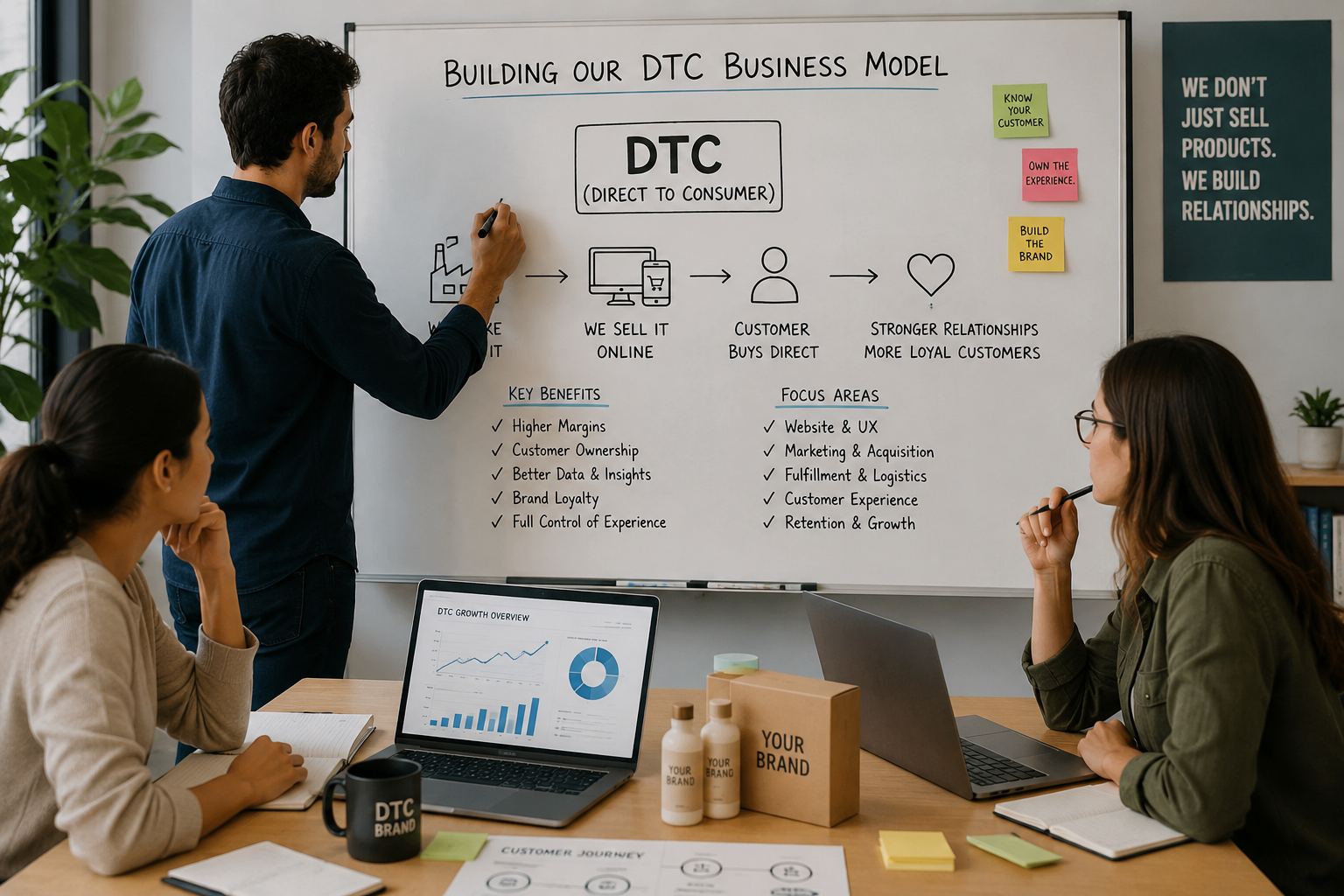
DTC brands control the whole selling process, which means handling manufacturing, marketing, selling, warehousing and reverse logistics in-house. The pandemic forced consumer-goods suppliers to manage complex retail supply chains and exacerbated strain on global operations. You’re responsible for returns processing that traditional retailers handled previously. Recent research found that 72% of businesses increased their proportion of domestic suppliers relative to international suppliers. Warehousing becomes a new cost center. Much of your cash gets tied up in inventory.
Customer acquisition costs have surged. Average ecommerce CAC climbed 40% to 60% between 2023 and 2025, with typical DTC brands now paying between $68 and $84 per customer. Shopify’s merchant-wide average reached $318 after a 16.1% jump in a single year. Competition drives up CPMs and CPCs on platforms of all types. Apple’s iOS privacy changes gutted pixel-based targeting and caused Meta CAC to jump an estimated 30% to 50%. A full 68% of DTC brands underestimate their true CAC by 20% to 40% because they count only paid ad spend.
Parcel shipping accounts for 15% to 20% of a brand’s net sales. Last-mile delivery, the final leg from fulfillment center to customer, represents 53% of total shipping costs. Research shows 68% of DTC brands cite frequent delivery delays as their top operational pain point. Customers expect same-day or next-day delivery. Late shipments trigger negative reviews, increased support tickets and long-term brand damage.
You need substantial marketing investment to sell without a physical presence. You won’t have the support of a preexisting supply chain or placement in national department stores to boost visibility. Brand awareness without store locations means you compete to get attention in crowded digital spaces where consumers face overwhelming choice.
Building a successful direct-to-consumer model requires strategic decisions in five key areas.

Shopify dominates DTC due to its ecosystem, ease of use, and strong checkout conversion. BigCommerce suits scaling brands needing native B2B/B2C features without transaction fees. Your team’s technical capacity, catalog size, and growth trajectory should drive platform choice.
Start by pinpointing your target customer segment and identifying their pain points. Then introduce campaigns that position your brand as the ideal solution. High-quality product detail pages need optimized images and complete descriptions. Vary your tactics beyond paid ads. Influencer partnerships, owned media, and community involvement help curb rising acquisition costs.
A full 71% of consumers anticipate customized interactions from companies. Consistent experiences at every touchpoint matter most. Customer Satisfaction Score and Net Promoter Score help you understand how customers notice your business. These metrics reveal what truly counts.
Marine Layer achieved profitability in 2011 by investing in physical stores early. These stores served as customer acquisition channels and limited social media ad spending.

3PL providers give you access to warehouses placed strategically. Their networks deliver one to two day transit time to over 98% of the US population.
The direct-to-consumer model offers most important advantages for brands willing to take control of their customer relationships. Higher margins and first-party data make it compelling, but challenges like rising acquisition costs and fulfillment complexities require careful planning.
Success comes from choosing the right platform and investing in a variety of marketing channels. Brands that become skilled at these fundamentals will thrive in the evolving DTC space and build long-lasting, profitable businesses in 2026 and beyond.
 Previous Post
